

Content marketing for contractors is about creating useful, relevant website content that helps potential customers find your business, understand your services and feel confident about hiring you. But getting results takes more than publishing a few blog articles. You need the right keywords, a well-structured website and content that attracts the right people at different stages of their buying journey.
In this guide, we’ll cover the four types of content contractors should prioritise, how to choose topics based on keyword research and what makes a website more likely to turn visitors into enquiries. We’ll also explain how SEO, AI search and content performance tracking fit into your wider marketing strategy.
4 Types of Content You Need to Generate Leads
Not all website content serves the same purpose. Some pages attract people who are ready to hire a contractor, while others help potential customers research their options, compare services or decide who they can trust.
A successful approach to content marketing for contractors uses different types of content to reach customers at each stage of their buying journey. Here are four types worth investing in and how to make each one work for your business.
1. SEO-Optimised Service Pages
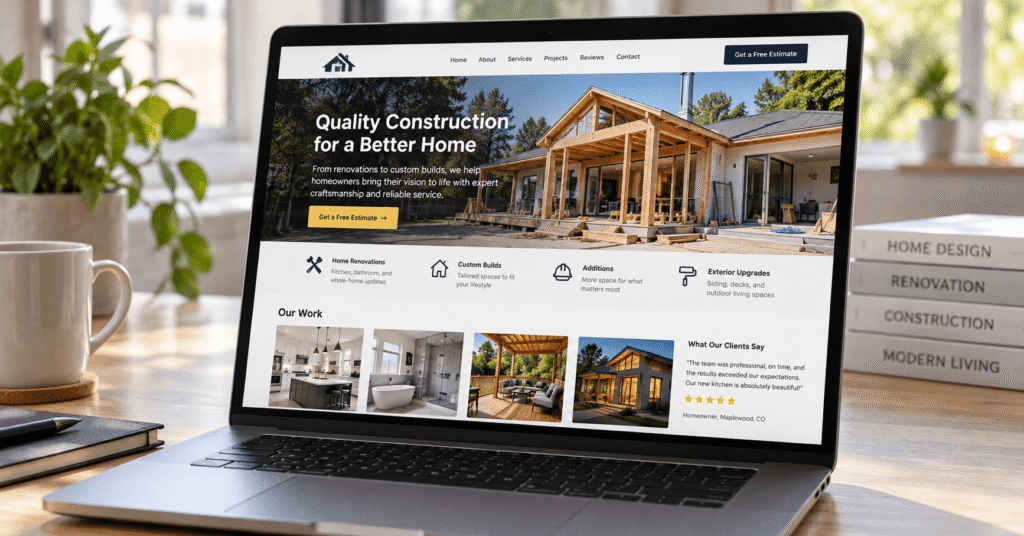
Your service pages are some of the most valuable pages on your website because they attract people who are actively looking to hire a contractor.
To get your service pages ranking for the right searches, you first need to understand search intent. This refers to what someone is trying to achieve when they search on Google, whether that’s finding information, comparing companies or hiring someone to do a job.
Google uses search intent to determine which types of pages are most relevant to a search. That means your content needs to match what the person is looking for if you want it to perform well in search results.
| Search Intent | What It Means | Contractor Keyword Examples |
| Informational | The person is looking for information, advice or answers to specific questions. | building quotation general contractor house construction |
| Navigational | The person wants to find a particular company, website or webpage. | Builders Warehouse Bunnings B&Q |
| Commercial | The person is researching or comparing building contractors before deciding who to hire. | Building contractor Construction companies Home builders |
| Transactional | The person is looking to take action, such as requesting a quote or hiring a contractor. | construction companies near me building contractors near me home builders near me |
When creating service pages, focus on commercial and transactional keywords. These help you reach potential customers who are further along in the buying process and more likely to make an enquiry.
A word of caution: Avoid creating multiple pages that target the same search intent. Each service page should have a clear purpose, target a distinct service and provide useful information to potential customers. Otherwise, you risk creating competing pages that dilute your SEO efforts.
What Should You Include on a Service Page?
A good service page should answer the questions a potential customer has before contacting you. It should also make it easy for them to take the next step.
Here’s what we recommend including:
- A clear H1 heading: Tell visitors exactly what service you offer, ideally incorporating your primary keyword naturally.
- An introduction that gets to the point: Explain what you do, who you help and where you operate. Don’t make visitors scroll to understand whether they’ve found the right contractor.
- A breakdown of your services: Explain what’s included, the types of jobs you handle and any specialist services you provide.
- Your process: Walk potential customers through what happens when they contact you, from the initial enquiry or inspection to completing the work.
- Pricing information: Where practical, provide starting prices, typical cost ranges or explain what affects the final quote.
- Real project photographs: Show visitors examples of completed work rather than relying entirely on stock photography.
- Customer reviews: Include relevant, genuine feedback that helps visitors feel confident about hiring you.
- Clear calls to action (CTAs): Make it easy to request a quote, book an appointment or contact your team.
Remember that your service page needs to work for both search engines and people. Ranking in Google is only part of the job. Once someone arrives, your content needs to give them enough information and confidence to enquire.
E-E-A-T and Trust Signals
Before someone hires a contractor, they want reassurance that the person entering their home or working on their property knows what they’re doing. This is where E-E-A-T plays an important role.
E-E-A-T stands for Experience, Expertise, Authoritativeness and Trustworthiness.
Google uses the concept of E-E-A-T when assessing content quality. It’s not a single ranking factor or a score you can improve, but Google’s systems look for signals associated with helpful, reliable and trustworthy content.
For contractors, demonstrating these qualities can be relatively straightforward because you have something generic websites don’t: real-world experience.
Consider including:
- Qualifications and accreditations: Show relevant trade certifications, licences, industry memberships and professional credentials. Only include accreditations you genuinely hold.
- Years of experience: Explain how long you’ve been operating and the types of projects your team has completed.
- Photographs of your work: Include original images that demonstrate your experience and the standard of your workmanship.
- Customer reviews: Feature authentic testimonials from customers who have used your services.
- Team information: Introduce your team and explain their relevant experience or specialisations.
- Business information: Make your contact details, operating areas and company information easy to find.
- Relevant case studies: Link to completed projects that demonstrate your ability to deliver the service being advertised.
These details make your business more credible to prospective customers while supporting the principles behind Google’s approach to evaluating helpful content.
Include FAQs About the Specific Service
Frequently asked questions are useful on service pages because they allow you to address concerns that might prevent someone from making an enquiry. Think about the questions customers regularly ask when they phone your business or request a quote.
For example, an emergency plumbing page might answer:
- How quickly can a plumber get to my property?
- Do you offer emergency plumbing outside normal working hours?
- Can you give me an estimate before starting the repair?
- What should I do while waiting for the plumber to arrive?
- Keep the answers specific to the service, straightforward and genuinely helpful.
One important tip: Don’t repeat questions you’ve already answered in detail elsewhere on the page. FAQs should add useful information, not duplicate existing sections simply to include more keywords.

2. Project Case Studies
You can tell potential customers that you deliver excellent workmanship, but showing them what you’ve done is far more convincing. Project case studies give visitors a closer look at your experience, the types of jobs you handle and the results you achieve.
They’re particularly useful for contractors because customers often want proof that you’ve successfully completed similar work before hiring you.
For example: A homeowner planning a kitchen renovation may feel more confident contacting a building contractor after seeing photographs of a comparable project, understanding the work involved and reading feedback from the customer.
Case studies also give you an opportunity to demonstrate your expertise through original content that competitors cannot easily replicate.
What Format Should You Use for a Project Case Study?
You don’t need to write a lengthy technical report for every project. A well-structured case study with useful details and good photographs can be enough to demonstrate your capabilities.
We recommend the following format:
- Project overview: Briefly explain what the project involved, the type of property and the general location, where appropriate.
- The customer’s requirements: Describe what the customer wanted to achieve or the problem they needed help solving.
- Your approach: Explain how your team assessed the job, planned the work and selected the appropriate solution.
- The work completed: Outline the main stages of the project, including any materials, specialist techniques or equipment worth mentioning.
- Challenges and solutions: If you encountered an unexpected issue, explain how you resolved it. This is an excellent opportunity to demonstrate practical experience.
- The finished result: Show what was achieved, preferably using clear photographs of the completed work.
- Customer feedback: Where available, include a genuine review or testimonial about their experience.
Present Your Customer and Their Property Respectfully
Be thoughtful about how you present the customer and their property.
For example, if you’re writing about a bathroom renovation, avoid describing the original bathroom as neglected or filthy. Instead, explain that the homeowner wanted to modernise the space, improve functionality or replace ageing fixtures.
The same applies to photographs. Before-and-after images can be extremely effective, but never publish photographs that could embarrass a customer or expose personal information. Always obtain permission before sharing images or identifying project details.
Your case study should make the customer feel proud of the finished result while demonstrating the quality of your work.
Add Evidence From the Customer
A completed project is even more convincing when the customer shares their experience. Including a genuine review or testimonial in your case study helps potential customers understand what it’s like to work with your team.
Look for reviews that highlight things such as:
- Communication: Did your team keep the customer informed throughout the project?
- Reliability: Did you arrive on time and meet agreed deadlines?
- Professionalism: Did your team treat the customer and their property with respect?
- Workmanship: Was the customer happy with the quality of the finished work?
- Cleanliness: Did your team keep the work area tidy and clean up afterwards?
Where possible, link directly to the original review on Google or another reputable platform. This allows potential customers to verify the feedback and adds credibility to your case study. Make sure you have permission to reproduce testimonials where required.
What about SEO: Customer reviews help build trust and encourage enquiries, but displaying or linking to them doesn’t directly improve your Google rankings. Google also restricts review-star rich results for businesses displaying reviews about themselves on their own websites.
The biggest benefit of including reviews is helping potential customers feel confident about choosing your business.
3. SEO-Optimised Blogs
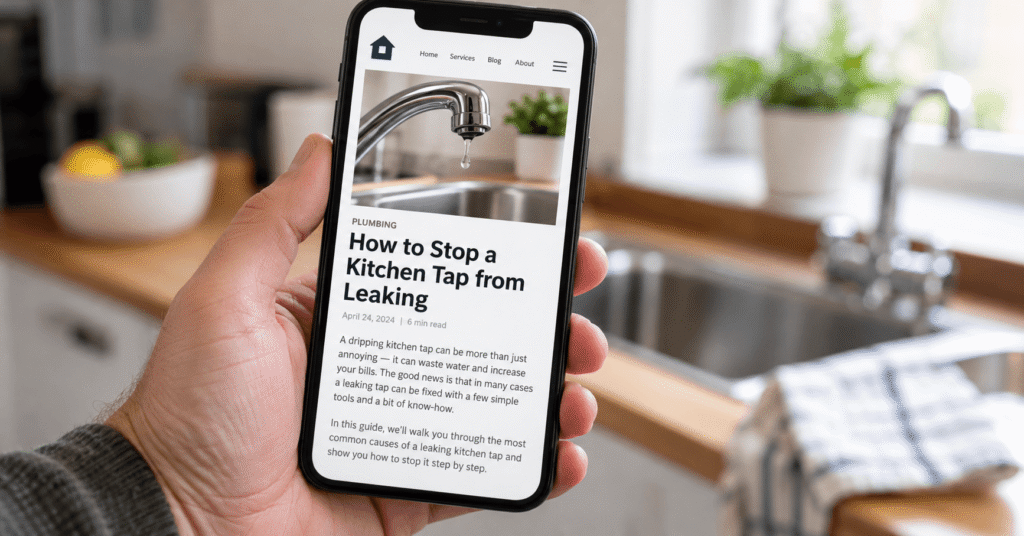
Blog articles play an important role in content marketing for contractors because they help you reach potential customers earlier in their buying journey, often before they’re ready to hire someone.
For example, someone searching for “how much does a home extension cost?” might not be ready to contact a builder just yet. They’re researching costs, weighing up their options and deciding whether the project is affordable.
If your blog answers their questions, you’re introducing your business to them before they’ve even started comparing contractors.
This is known as top-of-funnel marketing, and it helps you:
- Increase brand awareness: Introduce your business to people who might not have heard of you before.
- Build trust: Demonstrate your expertise by answering common questions and sharing practical advice.
- Increase organic visibility: Give your website more opportunities to appear in relevant Google searches.
- Support your service pages: Direct interested readers towards the services you offer when they’re ready to take the next step.
Important: Keep in mind that blog articles don’t typically generate as many direct enquiries as service pages. They certainly can generate leads, but their main purpose is usually to attract relevant visitors, build familiarity with your business and support future buying decisions.
What Topics Should You Post?
Before deciding what to publish, start with SEO keyword research. This helps you identify what potential customers are searching for, how much demand exists and which topics offer realistic opportunities to attract organic traffic.
For blog content, focus primarily on informational keywords, as these target people looking for advice, answers or guidance.
Keyword research tools such as Semrush, SE Ranking and Ahrefs can help you evaluate:
- Search volume: The estimated number of monthly searches for a keyword.
- Keyword difficulty: How competitive a keyword is and how challenging it may be to rank for.
- Search intent: Whether someone wants information, to compare options or to hire a contractor.
- Related keywords: Other relevant searches and questions you could address in the same article.
For example, a building contractor might identify opportunities around home extension costs, construction timelines, planning permission or building materials.
Important Considerations
The goal is to choose topics with relevant search demand, realistic ranking potential and a clear connection to the services you offer.
- Don’t chase high search volumes: A lower-volume keyword with less competition and strong relevance to your services may offer a better ranking opportunity than a popular keyword dominated by established websites.
- Validate customer questions: Use questions your customers regularly ask for inspiration, but check the search demand before committing to a topic. Even an excellent article may attract very little organic traffic if few people search for it.
- Check Google’s search results: Look at what’s already ranking for your chosen keyword. If Google predominantly shows service pages rather than blogs, an informational article may not match the search intent.
Create a Content Calendar
Once you’ve gathered a list of relevant keywords, organise them into a content calendar. This gives you a clear publishing plan rather than having to come up with new topics every time you want to write an article.
For contractors, your calendar could include:
- How-to and DIY guides: Help homeowners with smaller tasks they can safely tackle themselves, such as preparing walls for painting.
- Common customer questions: Answer questions about construction timelines, repairs or planning requirements.
- Cost and pricing guides: Explain typical project costs and the factors that influence pricing.
- Comparison articles: Help readers weigh up options, such as different roofing materials or types of flooring.
- Planning guides: Explain what homeowners should consider before starting a renovation or building project.
- Maintenance advice: Share practical tips for maintaining homes, equipment or completed installations.
- Industry regulations and accreditations: Explain relevant building regulations, permits, qualifications or industry standards.
What to Publish First
When deciding what to publish first, don’t simply choose the keywords with the highest search volumes. A keyword attracting thousands of searches might look appealing, but if established websites dominate the search results, a smaller contractor website may struggle to compete.
Instead, prioritise the strongest realistic opportunities by considering search demand, keyword difficulty, relevance to your services and your website’s current authority. Your content calendar should also identify which service page each article will support. Where appropriate, add internal links that help readers move from informational content to the relevant service.
How Often Should You Post?
There’s no set number of blog articles Google requires you to publish each month. However, from our experience managing SEO campaigns at Roundseed, we’ve generally seen the strongest growth when businesses publish at least one well-researched, SEO-optimised article per week.
Businesses publishing once or twice a month can still grow, but we’ve typically seen that growth happen more slowly.
Consistent publishing helps you build out your website’s coverage of relevant topics and gives you more opportunities to appear in search results over time. That said, quality should always come before quantity. Publishing four useful, well-researched articles is better than producing eight generic posts with little value.
Every article should target a worthwhile search opportunity, answer the reader’s question properly and have a clear purpose within your wider content strategy.
Should You Add Frequently Asked Questions?
Yes, FAQs can be a useful addition to your blog articles, particularly when there are related questions that don’t warrant an entire section of their own. They also give you an opportunity to address specific concerns that readers may have after reading the main article.
For example: A blog about home extension costs might include a short FAQ about whether architectural plans are included in a builder’s quote, provided the article hasn’t already answered that question.
Avoid repeating information already covered in the main article. If you’ve explained something in detail under an existing heading, there’s little value in asking and answering the same question again in an FAQ.
Only include FAQs when they add genuinely useful information and help readers leave with a clearer understanding of the topic.
4. Local Content
Local content is another important part of content marketing for contractors, particularly if your business serves a specific city or region. It helps you reach potential customers searching for services in the areas you cover.
For contractors, local content could include:
- Location-specific service pages: Dedicated pages for particular cities or regions, provided there’s enough unique information to justify them.
- Local project case studies: Showcase completed projects with photographs, project details and customer feedback.
- Local guides: Share advice on building regulations, planning requirements or conditions specific to an area.
- Service area information: Explain which locations you cover and direct visitors to your relevant services.
Avoid Creating Duplicate Location Pages
A common mistake is creating multiple service pages with almost identical content, changing only the location name. For example, a building contractor might create pages targeting multiple cities. If these pages contain essentially the same information, they offer little additional value to potential customers.
They can also create SEO problems, including keyword cannibalisation, where multiple pages on your website compete for the same or very similar searches.
Our recommendation: Only create separate location pages when you have enough unique, relevant information to justify them. This might include local projects, different services or location-specific building requirements.
Otherwise, a strong main service page that clearly lists the areas you serve may be a better approach.
Understand How Google Displays Local Search Results
Just because someone includes a location in their search doesn’t mean Google will prioritise your local service page or blog article. Google considers search intent when deciding which results to display, and local searches can produce very different results.
For example:
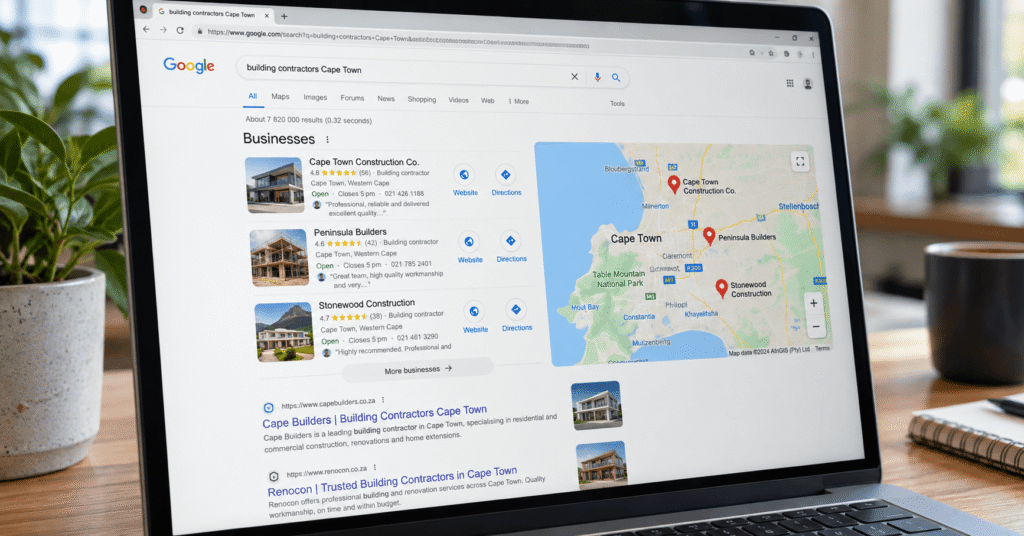
- “Building contractor London”: The person is likely looking for a contractor to hire. Google may prioritise Google Maps and Google Business Profiles, pushing traditional website listings further down the page.
- “How to choose a building contractor in Sydney”: The person wants advice on choosing a contractor, so an informational blog article may be more appropriate.
- “Best building contractors in New York”: The person is likely comparing businesses. Google may favour comparison articles, directories or local listings rather than a company’s own service page.
This is why checking Google’s search results before creating location-based content is so important. Look at what’s currently ranking for your target keyword. Are you seeing Google Maps, service pages, directories or informational blogs?
Use these results to guide your content strategy. You may find that creating a service page makes sense, while for other searches, improving your Google Business Profile or publishing an informational article could be more effective.
5 Things Often Overlooked When Creating Website Content for Contractors
Creating useful, SEO-optimised content is only one part of content marketing for contractors. How you organise, present and connect that content can also influence your search visibility and whether visitors decide to contact you.
1. Pillar Pages, Child Pages and Content Clusters
A clear website structure is an important part of contractor content marketing. It helps visitors and search engines understand how your services and content relate to one another. One way to achieve this is by organising your content into pillar pages, child pages and content clusters.
Here’s how they work:
- Pillar or parent pages: These cover a broad service or topic and link to more specific supporting pages.
- Child pages: These sit beneath a parent page and cover individual services in greater detail.
- Content clusters: These are groups of related articles and resources that support a particular topic or service.
For example, a building contractor might organise their website like this:
- Parent Page: Home Renovations
- Child Page: Kitchen Renovations
- Child Page: Bathroom Renovations
- Child Page: Home Extensions
Supporting Blog Content:
- How Much Does a Kitchen Renovation Cost?
- How Long Does a Bathroom Renovation Take?
- Do You Need Planning Permission for a Home Extension?
These pages should be connected through internal links. For example, a blog about kitchen renovation costs could link to your kitchen renovation service page, while that service page could link back to relevant guides and completed projects.
This makes it easier for visitors to find related information, while helping Google discover your pages and understand how your content is connected.
2. UX/UI Design and Page Layout
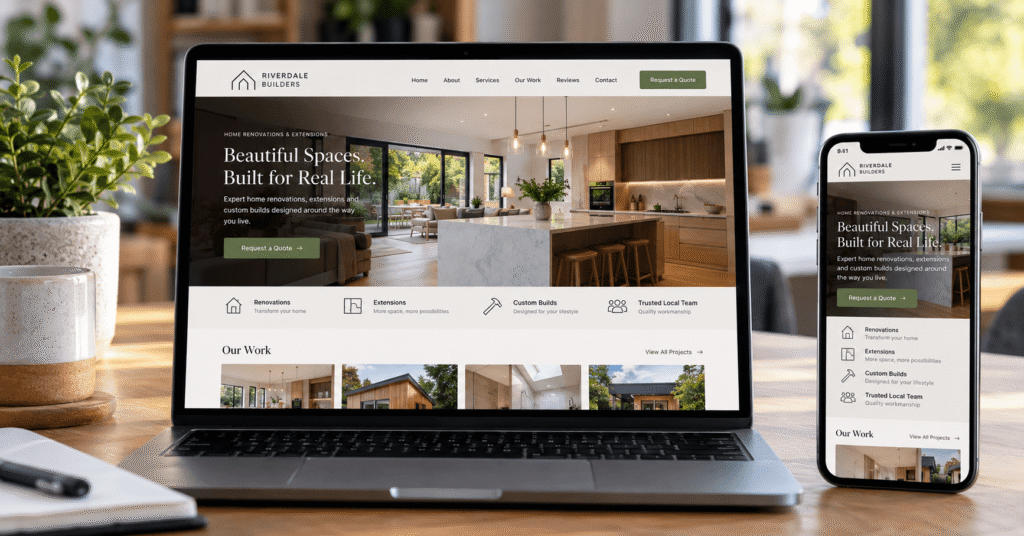
You could have excellent content, but if your website looks outdated, is difficult to navigate or makes information hard to find, potential customers may leave before contacting you.
According to a 2025 Clutch survey of US consumers, website design plays an important role in how people judge a business:
- 84% say website design influences whether they shop with a brand.
- 87% have left a website because it didn’t look trustworthy.
- 83% judge a website’s credibility within 20 seconds.
For contractors, this reinforces the importance of making a good first impression. Potential customers want to feel confident they’re dealing with a professional, reliable business before making an enquiry.
This is where UX and UI design play a crucial role:
- UX (user experience): How easy and intuitive your website is to use, from finding information to requesting a quote.
- UI (user interface): The visual elements visitors interact with, including buttons, menus, images and page layouts.
For contractors, a well-designed website should:
- Have a logical page flow: Present information in the order customers need it, from understanding your service to seeing proof of your work and making an enquiry.
- Be visually appealing: Use clean layouts, readable fonts, consistent branding and enough spacing between sections.
- Use high-quality imagery: Include genuine photographs of your team, completed projects and workmanship rather than relying entirely on stock images.
- Make navigation simple: Help visitors find services, project examples, contact details and other important pages without searching through complicated menus.
- Include clear calls to action: Make it obvious how someone can request a quote, call your business or book a consultation.
3. Optimise Your Content for Mobile Devices
More people browse websites on mobile phones than on desktop computers. According to Statcounter, 59% of worldwide web traffic came from mobile devices in September 2026, compared with 39% from desktop computers.
Mobile optimisation is also important for SEO because Google primarily uses the mobile version of your website’s content for indexing and ranking.
When reviewing your website on a mobile device, check that:
- Text is easy to read: Visitors shouldn’t need to zoom in to read your content.
- Pages load quickly: Large images and unnecessary scripts shouldn’t slow down the experience.
- Buttons are easy to tap: Calls to action, menus and contact buttons should work comfortably on smaller screens.
- Content displays correctly: Images, tables and page layouts shouldn’t extend beyond the screen.
- Important information is accessible: Visitors should be able to find your services, contact details and enquiry forms without difficulty.
Don’t assume that because your website looks good on a desktop computer, it works equally well on a phone. Test your most important pages on different screen sizes.
4. Metadata and Website Accessibility
Your SEO title and meta description are often a potential customer’s first introduction to your business in Google search results.
Think of them as your pitch to show someone why your page is worth clicking instead of the other 9 competitors on the page.
- SEO/Meta title: Write a clear, compelling title that includes your primary keyword and accurately describes the page.
- Meta description: Summarise what visitors will find and give them a reason to click. Focus on the information or value they’re looking for rather than repeating your title.
Google doesn’t always display your exact SEO title or meta description, but writing them carefully gives search engines useful information to work with. It’s also important to make your website accessible to people with different needs and abilities.
Simple improvements include:
- Descriptive image alt text: Explain meaningful images so people using screen readers can understand them.
- Clear headings: Use a logical H1, H2 and H3 structure to make content easier to navigate.
- Readable text: Choose legible font sizes and ensure sufficient contrast between text and backgrounds.
- Descriptive links: Use meaningful anchor text rather than vague phrases such as “click here”.
- Accessible forms: Make sure contact forms have clear labels, instructions and error messages.
These improvements make your content easier to use and help more potential customers access the information they need.
5. Keyword and Content Cannibalisation
Creating more pages doesn’t necessarily mean you’ll attract more traffic, particularly when several pages target the same search intent. This can lead to keyword cannibalisation, where multiple pages on your website compete for similar searches instead of supporting distinct topics or services.
For example, a building contractor might have three separate pages targeting:
- Home Renovation Services
- Professional Home Renovations
- Home Renovation Contractors
If all three pages serve the same purpose and contain largely similar information, Google may struggle to identify which one is the most relevant result. It may also choose to index or rank only one of them.
To avoid this:
- Assign a primary keyword and search intent to each page: Make sure every page has a clear purpose.
- Check existing content before publishing: Avoid creating a new article or service page when you already have one covering the same topic.
- Consolidate overlapping content: Where appropriate, combine competing pages into one stronger resource and redirect redundant URLs.
- Use internal links: Connect related pages so they support each other rather than unnecessarily competing.
It’s worth remembering that ranking for similar keywords isn’t automatically a problem. Cannibalisation becomes a concern when overlapping pages undermine the performance of the content you want Google to prioritise.
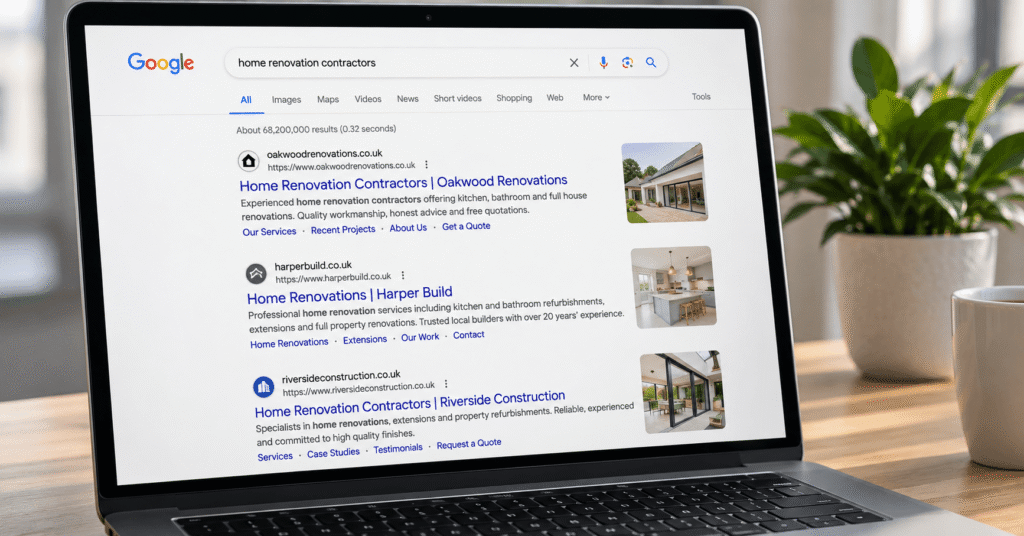
What Is SEO and Why Is It Still Necessary?
Search engine optimisation (SEO) is the process of improving your website’s visibility in search engines like Google, helping potential customers find your business when searching for relevant services or information.
Google uses automated systems to discover, understand and rank website content based on how relevant and useful it is to someone’s search. However, publishing excellent content doesn’t guarantee a place on Google’s first page. Several other factors can influence how well your website performs.
What Factors Affect Your Google Rankings?
Even if you’ve written an excellent article that answers the reader’s question, it doesn’t automatically mean Google will rank it on the first page. Google considers a range of signals when determining which pages to display and in what order. Your website’s technical performance, credibility and the strength of competing websites can all influence your chances of ranking.
Here are some of the key factors that can affect your SEO performance:
- Content quality and relevance: Your content should match search intent, answer questions thoroughly and provide useful, accurate information.
- Website authority: Established websites with strong reputations and relevant backlinks may have a competitive advantage. Metrics such as Domain Authority (DA) can help assess competition, although DA itself isn’t a Google ranking factor.
- Backlinks: Links from relevant, reputable websites can help Google assess the credibility and usefulness of your content.
- Website speed and performance: Slow-loading pages and poor user experiences can affect visitors and contribute to weaker search performance.
- Technical SEO: Google needs to be able to crawl, understand and index your website. Technical problems can prevent even excellent content from appearing in search results.
- Competition: Ranking for a highly competitive keyword can be difficult, particularly when established websites already dominate the results.
AEO vs GEO vs SEO: What’s the Difference?
AI is changing how people search for information online. Instead of browsing through multiple websites, potential customers can now use tools such as ChatGPT, Google’s AI Overviews and AI Mode to get answers, compare services and research contractors.
This has introduced two terms you’ll increasingly hear in digital marketing:
- AEO (Answer Engine Optimisation): Focuses on making your content easy for AI-powered search tools and answer engines to find, understand and use when answering questions.
- GEO (Generative Engine Optimisation): Focuses on improving your business’s visibility in AI-generated responses, including when AI tools recommend businesses or reference websites.
Do You Still Need SEO?
Absolutely. AEO and GEO don’t replace traditional SEO. In fact, many of the same principles apply. According to Google’s guidance on AI search, existing SEO best practices remain relevant to appearing in its generative AI search features.
For contractors, that means continuing to focus on:
- Helpful, original content: Share practical experience, project examples and expert advice that generic articles can’t easily replicate.
- Clear website structure: Use descriptive headings, logical page layouts and relevant internal links.
- Technical SEO: Make sure search engines can crawl, understand and index your content.
- Business credibility: Keep your business information accurate and demonstrate your experience through genuine projects, qualifications and customer feedback.
Important: AI platforms don’t all use the same systems to select and recommend content, and their exact selection methods aren’t fully disclosed. Following SEO best practices can improve your chances of being found, but there is no guaranteed formula for appearing in AI-generated answers.
How Do You Track Visibility in AI Search?
Measuring AI search performance is still developing, and no single tool provides a complete picture.
For now, we’d recommend monitoring:
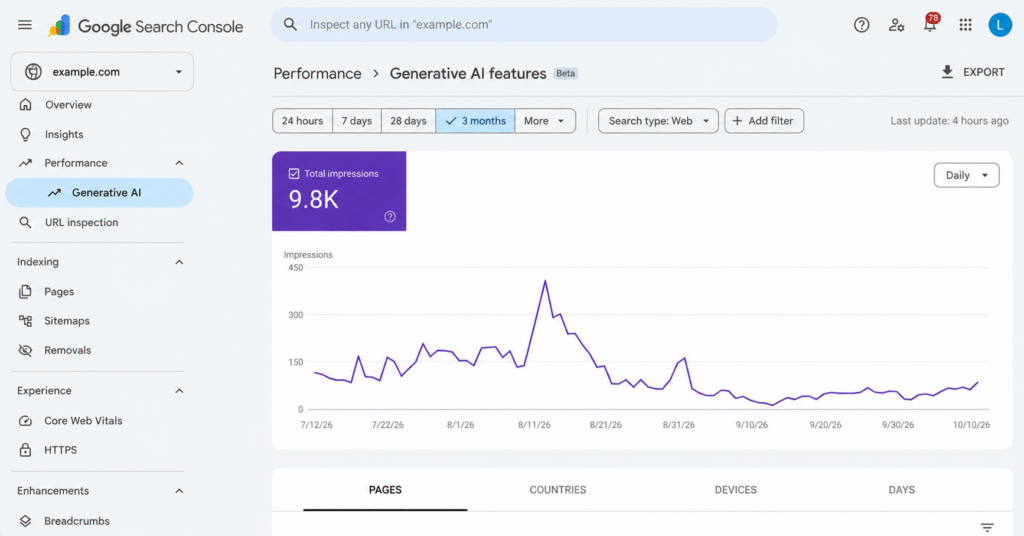
- Google Search Console: Use the Generative AI performance report to see impressions from AI Overviews and AI Mode, including which pages are appearing in these features.
- Google Analytics: Monitor referral traffic from identifiable AI platforms, such as ChatGPT, to see which pages attract visitors and whether those visitors make enquiries.
- Enquiries and conversions: Track contact form submissions, phone calls and quote requests to understand whether your content is contributing to business growth.
Limitations: Not all visits from AI tools are correctly attributed, particularly when people move between mobile apps and browsers. Some visits may appear as direct traffic, making it difficult to identify their original source.
Our advice: Keep investing in strong SEO fundamentals while monitoring AI visibility as an additional channel. The two approaches work together, and useful, original content remains a sensible foundation for both.
Can I Use AI to Create Website Content?
Yes! AI tools like ChatGPT, Claude and Gemini can help you research topics, plan articles, organise information and create first drafts. However, publishing AI-generated content without reviewing or improving it isn’t a good SEO strategy.
According to Google’s guidance on AI-generated content, using AI doesn’t automatically prevent your content from ranking. Google focuses on the quality, originality and usefulness of the finished content, rather than how it was created. The challenge is that AI doesn’t automatically know the things that make your contracting business different.
How to Make AI-Generated Content More Valuable
Your first-hand experience is one of your biggest advantages. Rather than relying entirely on generic AI-generated information, enrich your articles with:
- Real project experience: Explain challenges you’ve encountered on jobs, how you solved them and what you learnt.
- Customer questions: Include questions your team regularly receives and provide answers based on your experience.
- Professional recommendations: Explain which materials, products or techniques you recommend and why.
- Local knowledge: Discuss building regulations, weather conditions or other factors specific to your service area.
- Accurate pricing: Include genuine cost estimates, pricing considerations or examples from your projects where appropriate.
- Original images: Use photographs of completed work, equipment or your team to support your explanations.
- Credible research: Include relevant statistics, industry guidance and links to reputable sources where they add value.
Example: AI can write a general article about common problems during home renovations. However, a building contractor can explain which issues they encounter most frequently, how those problems affect project timelines and what homeowners can do to prepare. That’s the kind of practical insight that makes an article more useful to potential customers.
Always Review AI Content Before Publishing
AI-generated information isn’t always accurate. It can produce outdated advice, incorrect figures or even references to sources that don’t exist.
Before publishing, make sure you:
- Fact-check claims: Verify statistics, regulations, prices and technical recommendations against reliable sources.
- Check for originality: Add your own expertise rather than simply repeating information already available on competing websites.
- Review the tone: Make sure the article sounds natural, reflects your business and speaks directly to your customers.
- Check search intent: Confirm that the finished article answers what someone searching for your target keyword wants to know.
Our recommendation: Use AI to make content creation more efficient, but don’t let it replace your professional knowledge. Combining keyword research, useful information and genuine experience is the foundation of effective content marketing for contractors, helping you create content that customers and search engines can trust.
Need Help With Content Marketing for Contractors?
Effective content marketing for contractors takes more than publishing a few blog articles. From keyword research and SEO-optimised service pages to website design, technical SEO and tracking performance, there’s a lot to consider. The good news is that when everything works together, your website can become a valuable tool for attracting potential customers and generating enquiries.
We know you’re busy managing projects, working on-site and running your business, so finding time to manage your website and content isn’t always easy. Why not leave it to us? At Roundseed, we’ve worked with building contractors, home builders, plumbers, security contractors and other trades. We combine SEO, content marketing and web design to help contractors improve their online visibility and attract more enquiries. Book a call and let’s talk about how we can help grow your business.